A fire alarm goes off in an apartment building. Everybody is out in the car park. Somebody asks whether the contractors got out.
In most buildings the answer to that is a guess. The plumber might have left an hour ago. The lift technician might still be in the motor room. Nobody standing in the car park knows, and there is no list to check.
Strata Check-In has always known who signed in. What it did not have was one place to see who was in the building right now, which is the only thing that matters while the alarm is still ringing. That was the gap, and it is now closed.
One screen, read in a car park
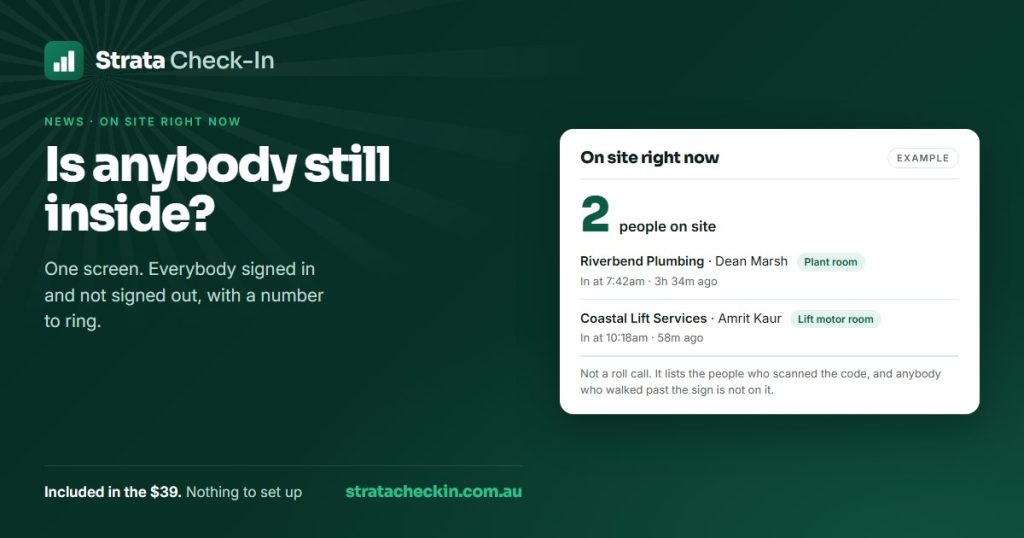
There is one screen that shows everybody who is signed in and has not signed out. It is set in the largest type in the product, because of where it gets read: on a phone, one handed, outdoors, by somebody who is not calm.
- Who is still signed in. Everybody who scanned the code and has not signed out.
- How long they have been in. Longest first, so the contractor who arrived at seven sits above the one who arrived ten minutes ago.
- Where they said they were headed. The plant room, the roof, the pool, common areas. Only if the building switches that on.
- Their mobile, as a link. Ring them from the assembly point without looking anything up.
Where they are headed is worth a word. A building that switches it on writes a short list of places, and contractors pick one when they sign in. One tap, so it does not slow anybody down. A manager can also mark a place to ask for a unit or lot number, and most buildings leave that off, because a unit number is a fact about somebody’s home as much as about the contractor.
What it is not
I want to be careful about this part, because it matters more than anything else in this post.
It is not a roll call, and Strata Check-In is not a fire safety system. The screen lists the people who scanned the code. Anybody who walked past the sign without scanning it is not on it. The screen says so on its own face, and it replaces nothing your building already has to do. Your evacuation procedures, your wardens and your fire safety obligations stay exactly as they are.
What it is, is better than standing in a car park guessing. On a bad day it is one more thing to look at, and one more thing is worth having.
What it costs
It is included in the $39 a month per building, and there is nothing to set up. Anybody signed in is on it from the day a building goes live.
It also depends on the thing the rest of the system is built around, which is contractors signing out. The one tap sign-out link in their text is what keeps this screen honest. Anything still open at the end of the day is closed automatically, so yesterday’s plumber is never on today’s list.
You can open the screen without a login. Every name, time and place on it is made up.